
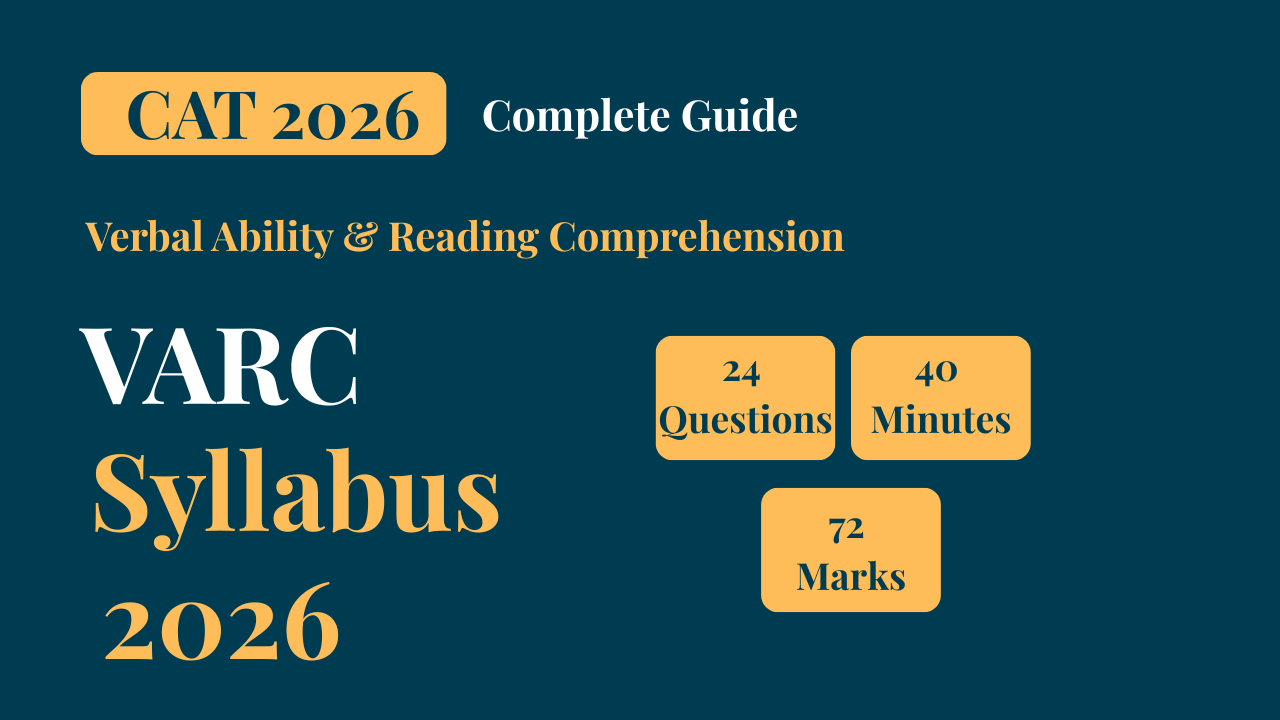
CAT 2026 VARC Syllabus
If CAT 2026 is on your radar, VARC is the section where a lot of scores are won (or lost) through speed, comprehension, and accuracy. The good news? VARC has a syllabus and a skill set you can train systematically, not by random reading or only doing passage practice.
This guide breaks down the CAT 2026 VARC syllabus in a practical way and gives you a clear strategy to reach 99+ percentile.
What is VARC in CAT 2026, and why does it matter?
VARC typically contains two parts:
- Reading Comprehension (RC)
- Verbal Ability (VA)
Because CAT is a timed exam, VARC rewards two things we can actually work on:
- Skills (speed, comprehension depth, retention)
- Techniques (how to approach each question type and eliminate options)
Also, VARC does not only affect CAT. The same communication strength helps in stages like Personal interview and written ability tests.
CAT 2026 VARC syllabus: the exact building blocks
Let’s map VARC into the areas you need to prepare. Expect CAT RC and VA question formats to be varied, but the “testing focus” stays consistent.
1) Reading Comprehension (RC)
RC is usually the dominant portion of VARC. Passages come from diverse topics, so the syllabus is not limited to one subject. You should be comfortable across genres like:
- Science and technology
- Economics and society
- Ecology and environment
- Psychology and philosophy
- Anthropology and sociology (often)
- Biology and research-based writing (commonly)
RC question types you should be ready for:
- Main idea and global understanding
- Title selection based on the passage theme
- Inference questions (what can be concluded)
- Author’s tone or purpose
- Strengthen or weaken logic-based options
- Fact-based questions
- Meaning of a sentence or context-based interpretation
One important reality: some RC questions test critical reasoning disguised as reading. So, your RC preparation must include argument logic, not just “reading the passage.”
The 3 RC skills you must build (not just do passages)
People often think RC is only about practicing passages. Practice is necessary, but it won’t help unless you build the right skills.
Skill 1: Increase reading speed
In CAT timing, even small speed gains matter because you earn extra minutes to think through options carefully.
Action plan: Add a daily speed-reading slot (about 15 minutes).
Skill 2: Improve comprehension depth
Many mistakes come from, reading but not extracting full meaning. Train comprehension by reading material that is just beyond your comfort level.
Action plan: Spend about 25 minutes on challenging non-fiction. Aim to understand around 70 to 80%.
Skill 3: Improve passage retention
Retention means you can build a quick mental overview after reading. Without it, answer choices look confusing.
Action plan: Pick an editorial or similar article, read it once, then write a short memory-based summary of the key ideas.
RC strategy inside the exam: reading or questions first?
This is a common question. There isn’t one universal best approach. Instead, you should choose based on the passage type and question set.
- If questions look fact and detail-heavy, read with a purpose and underline key lines.
- If questions are inference and author logic, prioritize understanding the argument flow before answering.
- If you’re consistently losing time, test a “questions-first” approach on selected practice sets and compare accuracy.
Do a few timed experiments. Your goal is to find the method that gives you the best accuracy per minute.
2) Verbal Ability (VA)
VA focuses on paragraph-based grammar and writing logic. The syllabus is mostly made of question types like:
- Paragraph Summary
- Paragraph Jumble
- Odd One Out
- Paragraph Completion
A good preparation order is usually the same as given above. These are not just “English questions.” They test how well you understand flow, coherence, grammar, and logical relationships in a paragraph. Focus on identifying how sentences connect through cause-effect, contrast, examples, and continuity. Learn to spot opening statements, mandatory pairs, and logical transitions.
Once this foundation is strong, basic grammar and vocabulary can support accuracy, especially in eliminating confusing options. However, CAT rarely tests Grammar and Vocabulary directly, so they should not be your primary focus. Instead, develop the habit of reading well-structured articles and mentally analysing how arguments are built. This improves both speed and accuracy in VA, making it easier to handle even unfamiliar or abstract content.
For the knowledge base part:
- Vocabulary: 15 to 30 minutes daily using a structured list and revision
- Grammar: Do consistent practice, not only theory
Common VARC mistakes to avoid
- Only practicing passages without building speed, comprehension depth, and retention
- Ignoring critical reasoning in RC
- Not learning question type signals (like strengthen/weaken, main idea, inference)
- Skipping review after mistakes. Your error patterns are the syllabus for your improvement.
- Uncontrolled practice with no timing and no accuracy targets
FAQ: CAT 2026 VARC syllabus and strategy
1) Is CAT VARC mostly Reading Comprehension?
RC is usually the major part, but VA is equally important. A 99+ plan balances both instead of over-focusing on one.
2) How many RC passages should I solve for CAT 2026?
Start with about 10 passages per week. One passage per day for 6 days and a 4-passage timed set on 7th day, then increase based on accuracy.
3) Do I need to read newspapers like The Economist and New York Times for CAT VARC 2026 preparation?
They can help because they build non-fiction comprehension, but the goal is “appropriately challenging reading.” If you’re not comfortable yet, start with editorials or simpler non-fiction and progress gradually.
4) Should I read the entire passage first or read questions first in CAT RC?
Test both methods during practice. Choose the one that gives higher accuracy under time pressure. Many students do better with purpose-driven reading and quick question mapping.
5) How is the VARC section divided between RC and VA in the Common Admission Test?
Typically, RC accounts for around 16 questions, while VA contributes about 8 questions, making RC the dominant part of the section.